
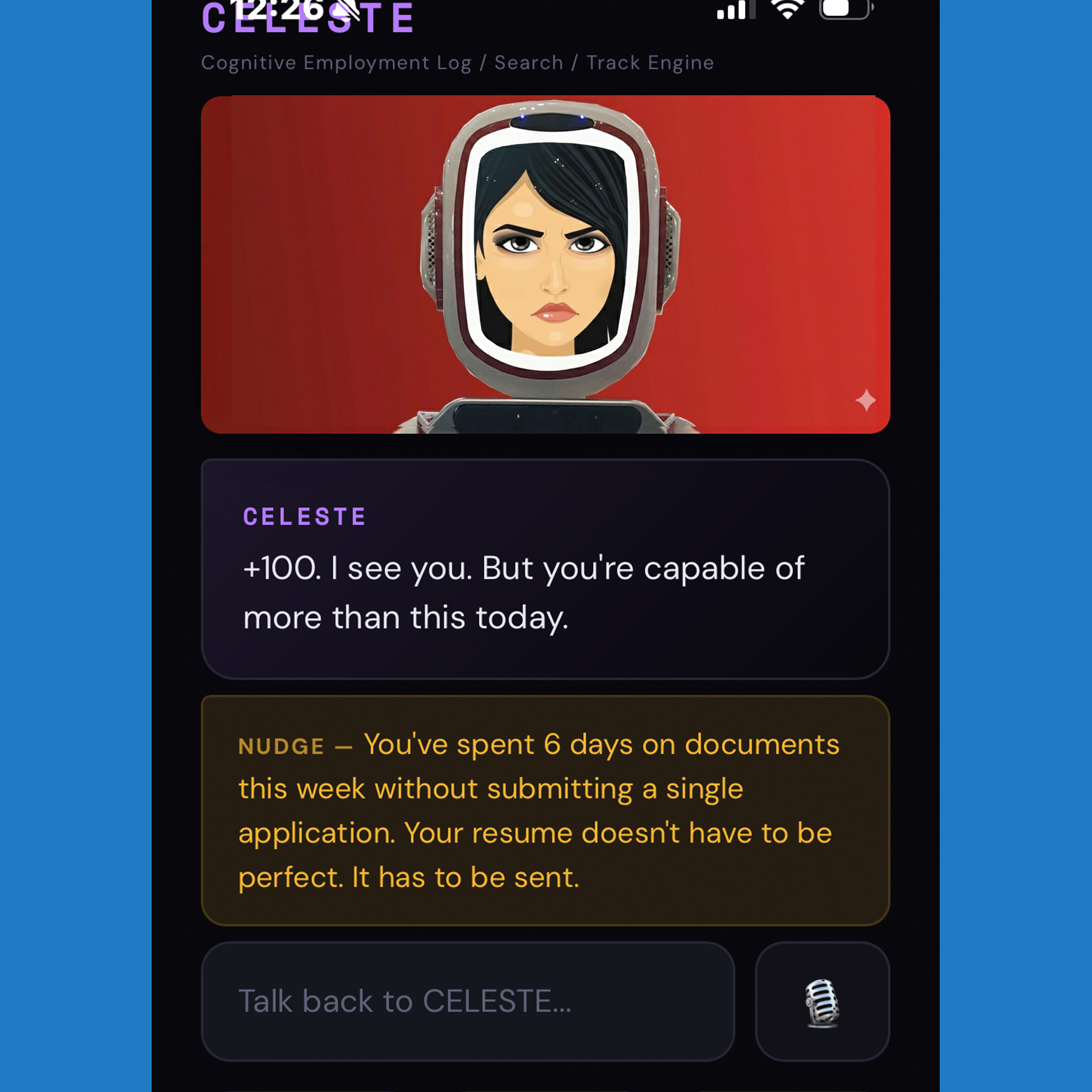
CELESTE neutral face replying to an antipattern, with corresponding nudge. May 2026.
CONTEXT
The answer to sycophantic AI: No-nonsense AI.
Years ago, when I was a Creative Director at Comedy Central developing apps in the early app market, I had an idea for a calorie-counting app with comedian Jeffrey Ross. Instead of the typical "You're doing great!" feedback that fitness apps give, you'd get roasted. Log a donut after 9pm and it might say something like: "Late-night donut? That's not a snack, that's a cry for help with sprinkles on it."
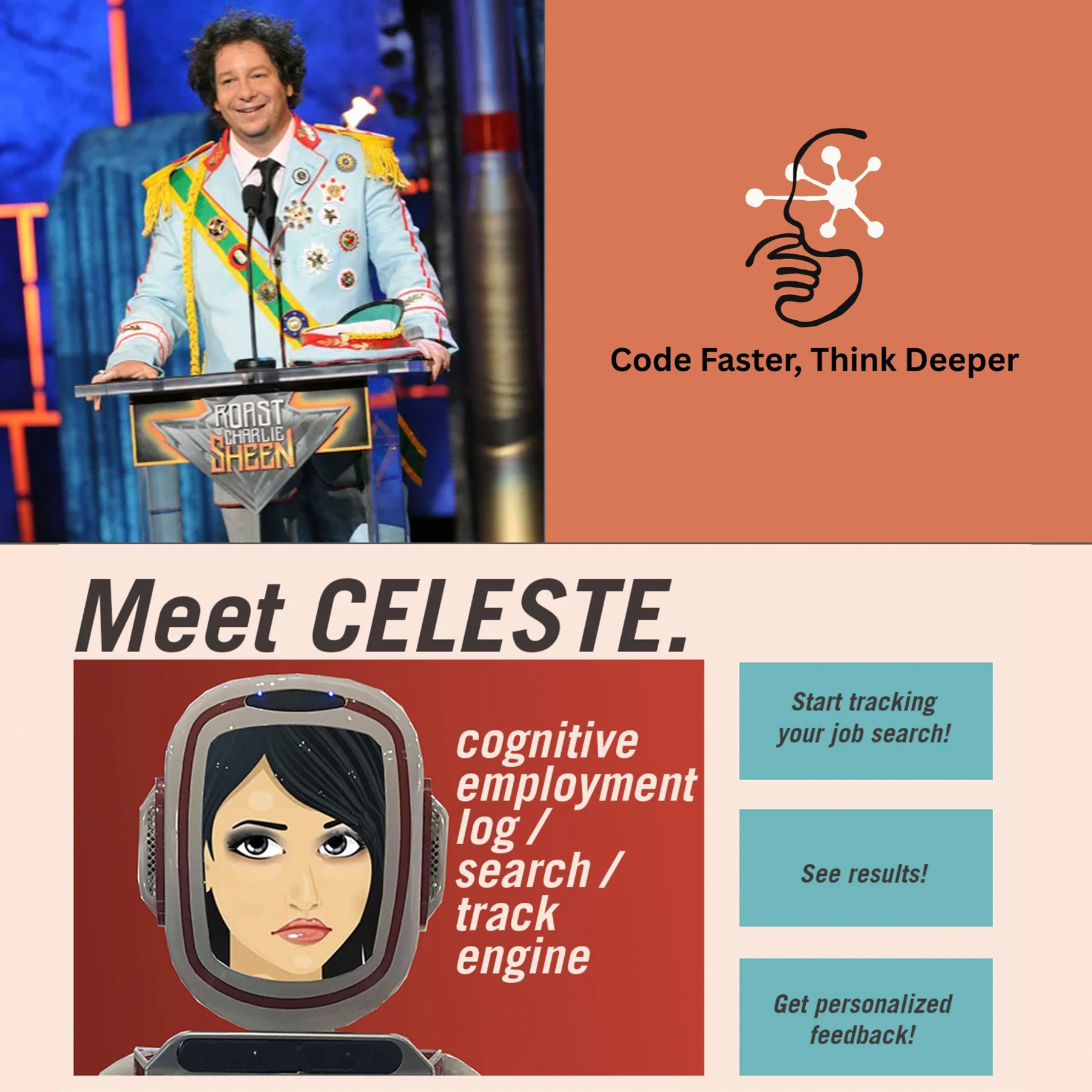
Top Right: Jeffrey Ross at the Roast of Charlie Sheen, August 2011. Top Left: Claude Code advertisement, 2026. Bottom: Early CELESTE design from my final project for a UX Design course at General Assembly in NYC. November 2018.
The hypothesis was that some people respond better to honest, spicy feedback than to insincere positivity. The idea didn't ship, but it stuck with me.
When I started job searching in 2016, I realized the same principle applied. A job search requires a lot of distinct, discipline-demanding actions: managing documents, applying strategically, staying in touch with contacts, preparing for interviews. I wanted to gamify it — give yourself points for doing the things that actually matter for getting hired. That idea evolved into a virtual assistant with real personality. I called it CELESTE — Cognitive Employment Log / Search / Track Engine.
I developed the concept, designed the UX as a final project in a UX course in 2018, built out the character. But I couldn't find a coding partner to build it. So it sat on the shelf, for years.
Then earlier this year after I left Amazon I made a decision: vibe coding — actually building things myself using Claude and AI tools — is the skill set that matters in 2026. CELESTE was the perfect project to revive. I needed it. I could iterate on it in real time. And now I had the tools to build it myself.
I spun up a working prototype in 48 hours.

THE SITUATION
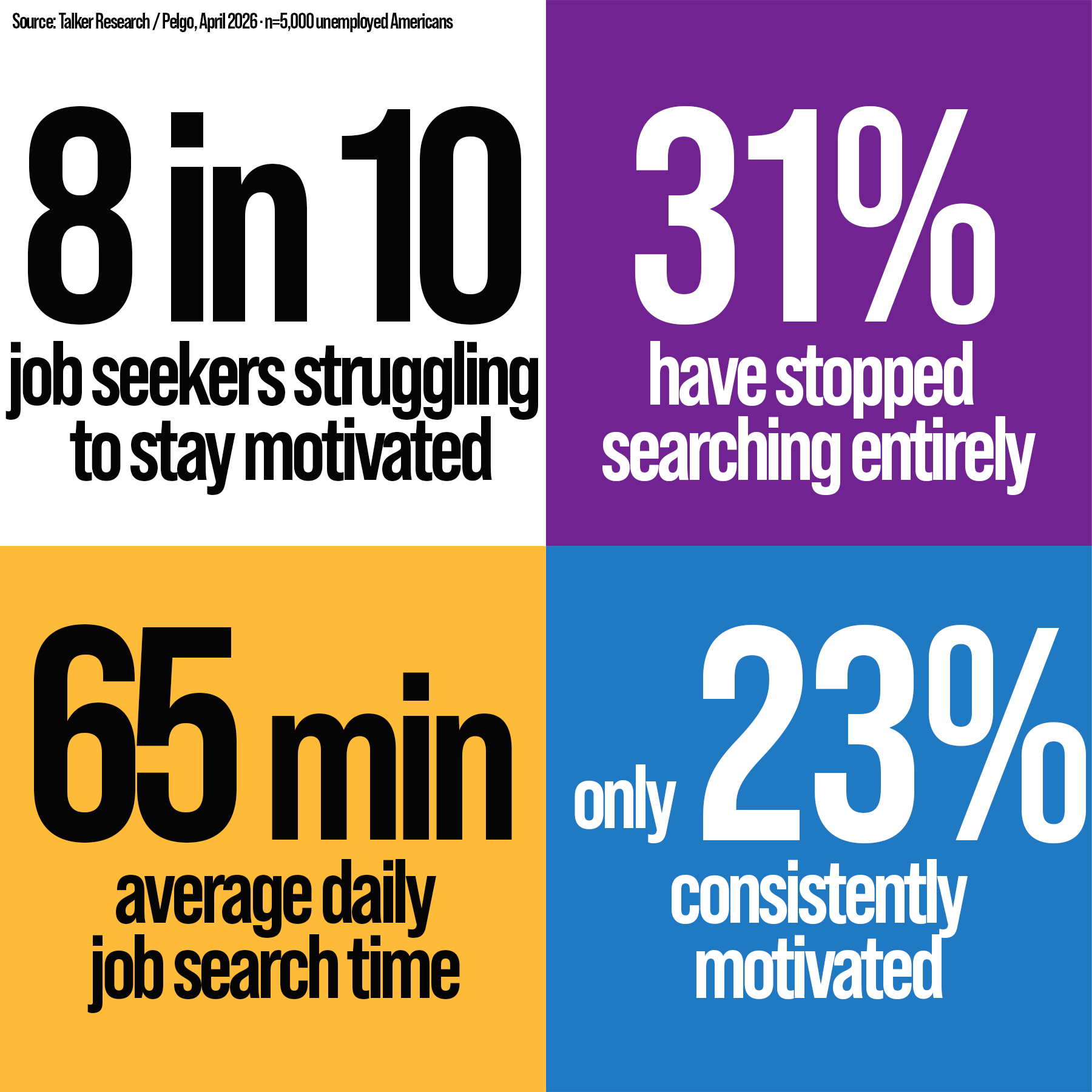
Job search motivation in 2026: key statistics from a Talker Research study of 5,000 unemployed Americans commissioned by Pelgo. April 2026.
In 2026, the job search has become a psychological endurance sport.
A 2026 study of 5,000 unemployed Americans found that 8 in 10 unemployed Americans are struggling to find the motivation to continue their job search. Just 23% are consistently motivated. A third have stopped actively searching. One in four admits feeling hopeless about the market at times.
This isn't laziness. It's what happens when the system is designed to wear you down.
AI has made the problem structurally worse. Everyone is using it to polish their resume, game screening algorithms, and prep for interviews — which means the baseline has risen for everyone and the signal-to-noise ratio for hiring managers has gotten worse. 37% of job seekers say AI has been helpful in their search, with 40% using it to keep up with what jobs in their field are looking for. But when everyone has a perfectly optimized résumé, the résumé stops being the differentiator.
What actually gets people hired in 2026 is the same thing that always got people hired: sustained, consistent, targeted effort across multiple fronts — applying thoughtfully, networking actively, staying visible, following up. Not doing any one of those things brilliantly. Doing all of them, every day, without stopping.
The problem CELESTE was designed to solve isn't a lack of tools. It's a lack of momentum. The average unemployed American spends just 65 minutes a day on their job search. That's not enough — and worse, it's easy to fill that 65 minutes with the wrong things and feel like you've worked hard.
CELESTE is the system I built to fix that for myself.
THE OBSTACLE
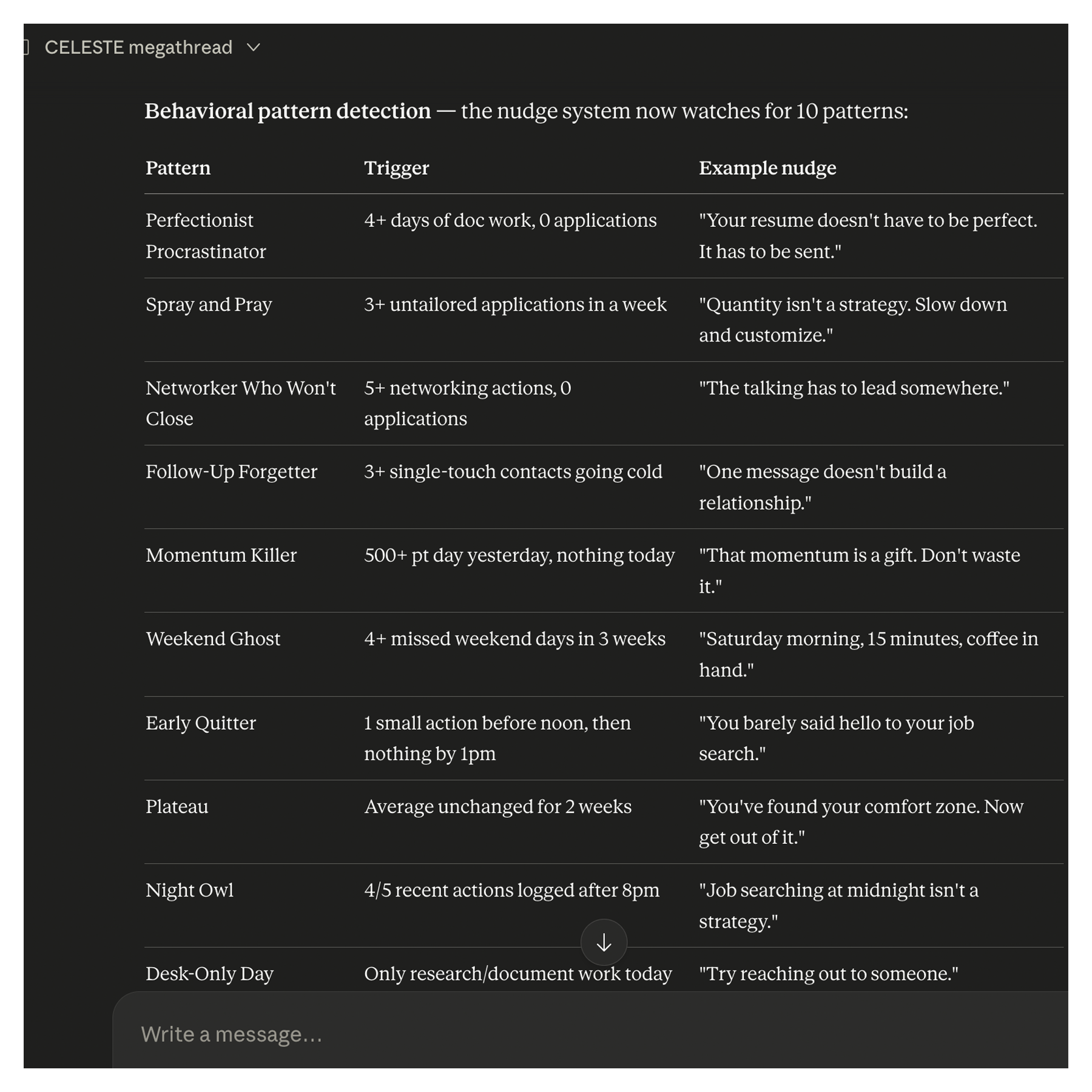
Portion of CELESTE megathread in Claude showing behavioral antipattern detection system where it showed 10 patterns, triggers, and example nudges to look for in Job Search Data. February 2026.
The idea had sat on a shelf for years because I needed someone else to build it.
That was the real constraint. I had the concept, the character, the UX. But without a technical partner, CELESTE stayed conceptual. Finding that partner was hard. The idea aged out twice.
When I came back to it in 2025, the obstacle had changed. The tools had caught up to the idea. With Claude Code, the question wasn't whether I could build it, but how do I design a system that doesn't just track job search actions, but does it in a way that's genuinely useful for decision-making? And how do I design the personality so it measurably affects behavior instead of just logging data?
WHAT I DESIGNED AND BUILT
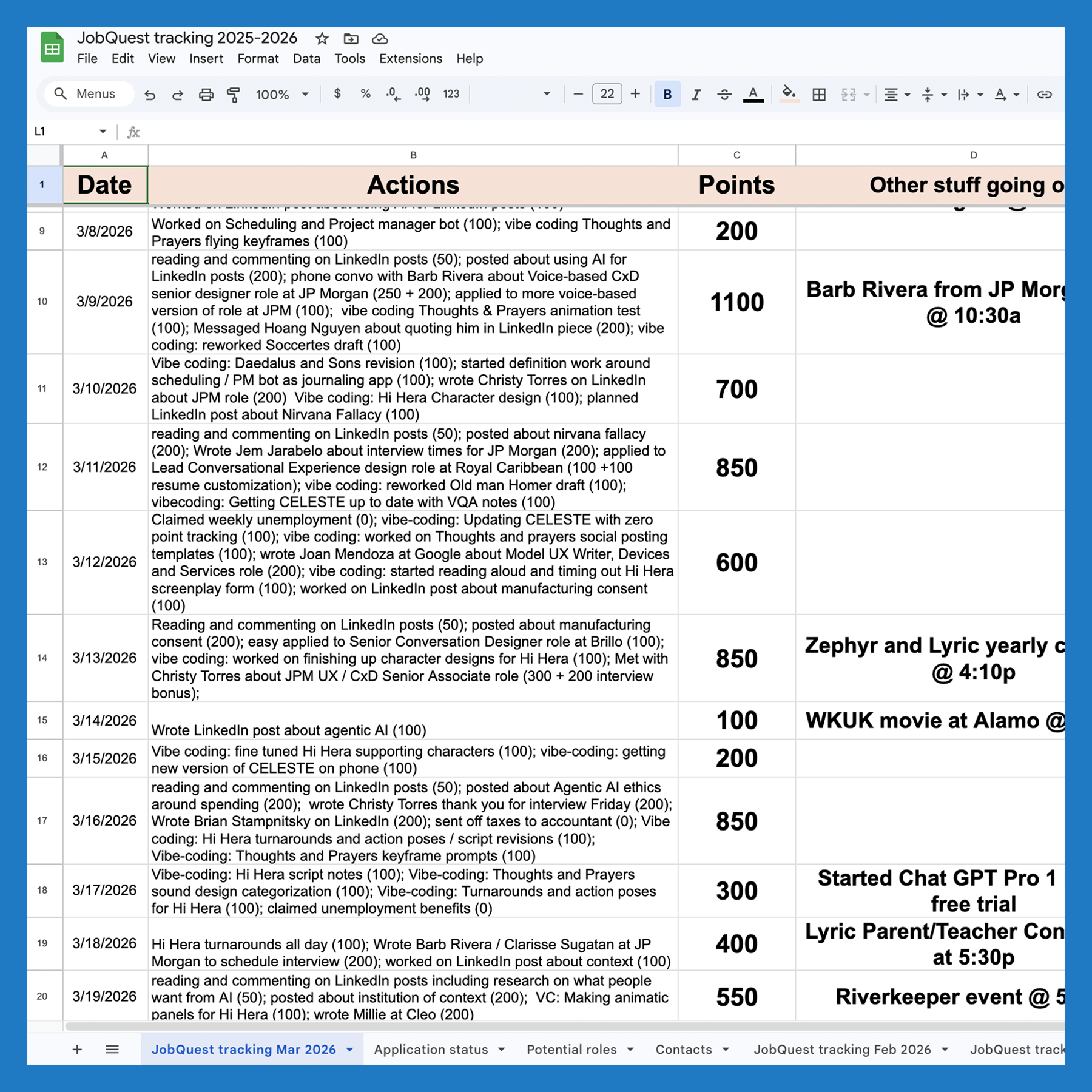
JobQuest tracking spreadsheet: months of job search action data that informed CELESTE's point system and behavioral pattern detection. March 2026.
A tracking system, a coach, and a character — all the same thing.
I'd been thinking about this for years, and personally living within the gamified system I created when job hunting. I had months of data about job search actions: applications, roles I was researching, contact lists, point averages, and more. I worked conversationally with Claude to understand: What patterns could we find in this kind of data? What would actually help people make better decisions and identify common pitfalls (like working a lot on your resume and website but never applying to jobs, or tracking only at the end of the day, or sending out mass unspecialized job applications)? That informed the system design.
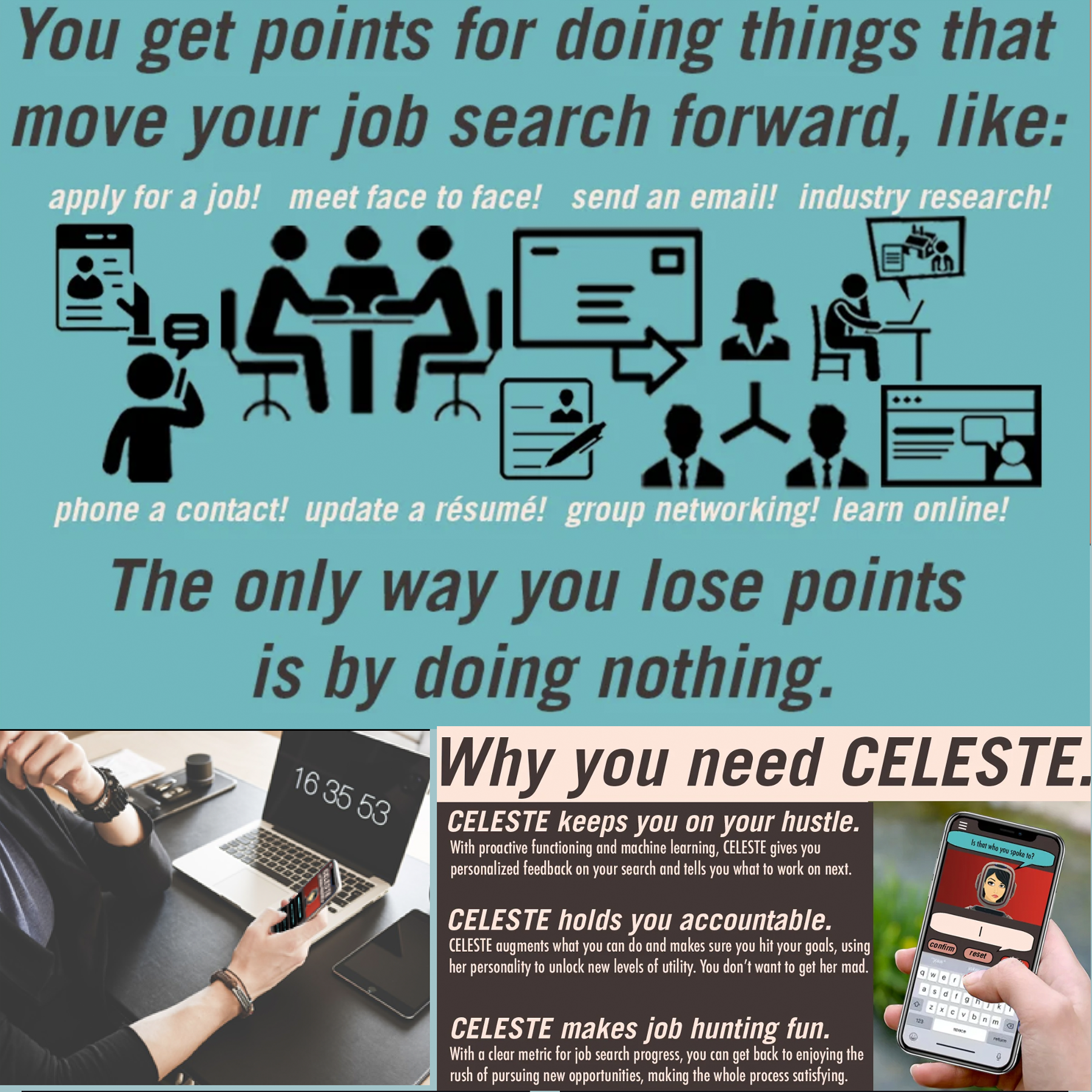
CELESTE's points system as explained in my 2018 pitch: job search action categories and weighted point values designed to reward high-conversion activity. November 2018.
The point system
CELESTE rewards all sorts of job search actions, and suggests some actions you could be doing to get more points in nudge messaging. For example:
A face-to-face meeting earns 300 points, a phone call gets you 250 points, and digital communication (email, LinkedIn message, text) gets you 200 points.
A job application earns 100, but with a 100 point bonus if you revise your résumé with it.
Fifteen minutes of industry research earns 50 points.
Working on personal professional documents (résumé, portfolio, website, etc) is 100 points (per document per day)
The only way you lose points is by doing nothing. This scoring is based on years of tracking what actually converts. The system steers you toward high-value contact and connection and away from the false productivity of busywork.
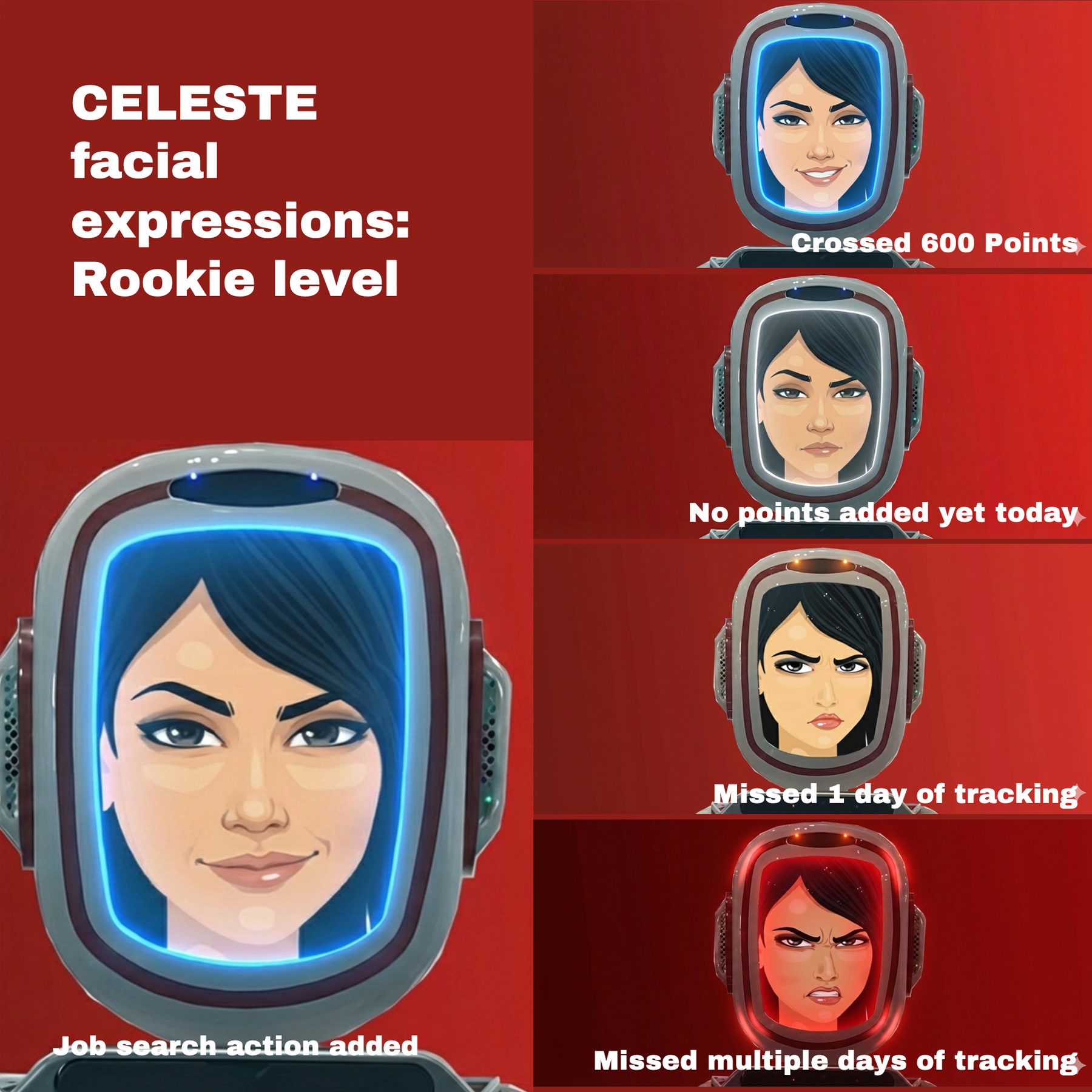
CELESTE facial expressions at Rookie level: five emotional states tied to daily point performance and tracking consistency. March 2026.
The personality
This was the critical design challenge. I designed CELESTE as a "Tiger Mom": always pushing, always with ideas for what you could do next, celebrating wins but calling you out when you're coasting. She has different facial expressions that shift with your performance:
Smiling when you cross 600 points in a day or get an interview bonus
Reserved when you haven't logged anything yet or do something indicating an antipattern (i.e., too much of one particular type of job search action)
Skeptical when you've missed a day
Flat-out angry when you've missed multiple days
I used focused meta-prompting to get a range of different emotional facial responses over a range of user contexts (first time user, user in their first month, 1 month users with a daily average below 300, 1 month users with a daily average 300-600, 1 month users with a daily average above 600). It’s incredible what a facial expression can communicate and how it can drive responses: I don’t want to get CELESTE angry and see her mad face.
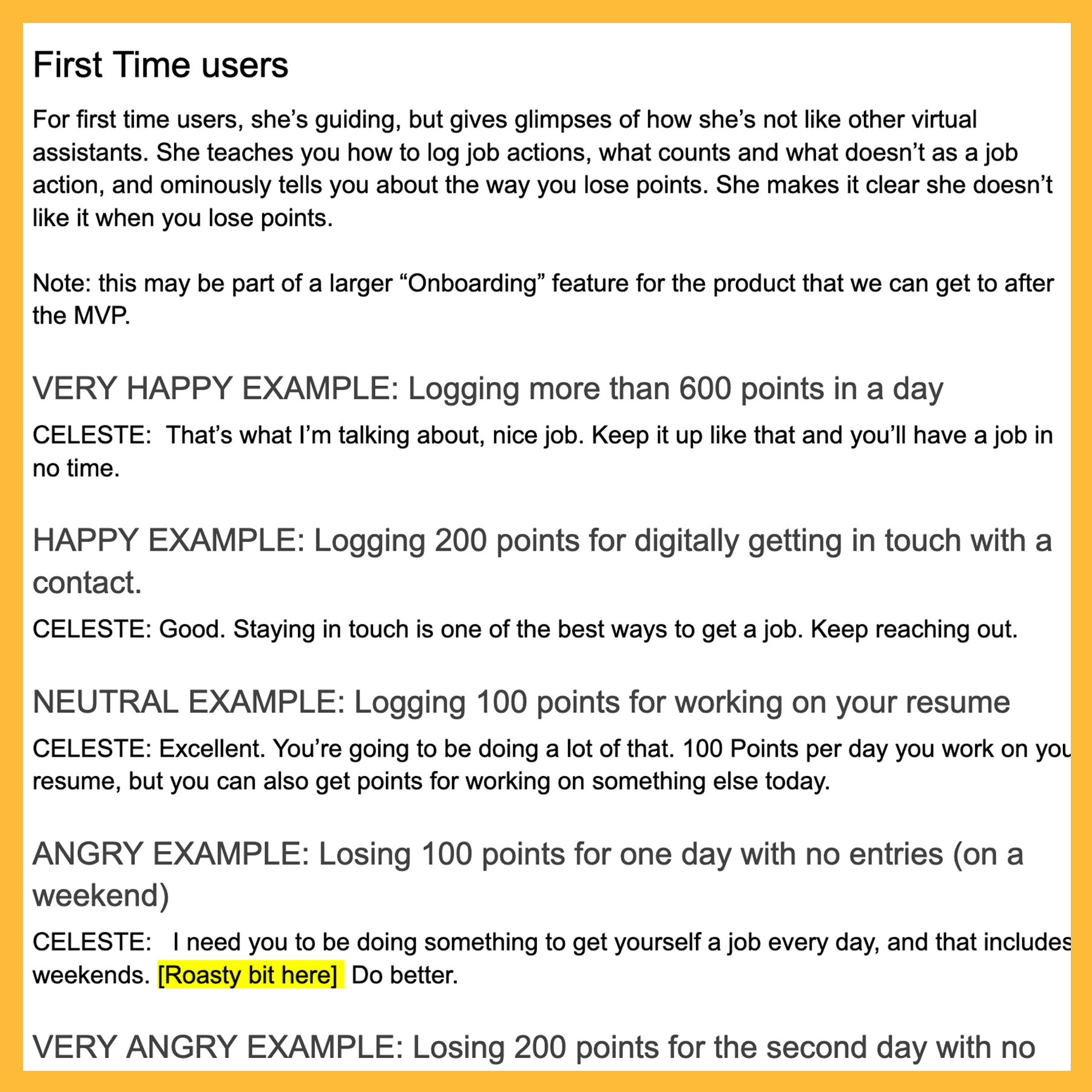
Prompt design for first time user messaging style. February 2026.
I also developed a range of chat responses for CELESTE to get her tone right, and by varying the responses and coordinating them with various actions, Claude caught on very fast. This was about training on good and bad examples and working out strong tone guidelines within prompting documentation. When I put in ways to chat with CELESTE at any point and she honestly surprised me with her comeback, I knew I was on to something special.
CELESTE’s personality isn't decoration. The personality is the utility. She's more than a tracker that happens to have a voice. She's a presence that changes how you behave.
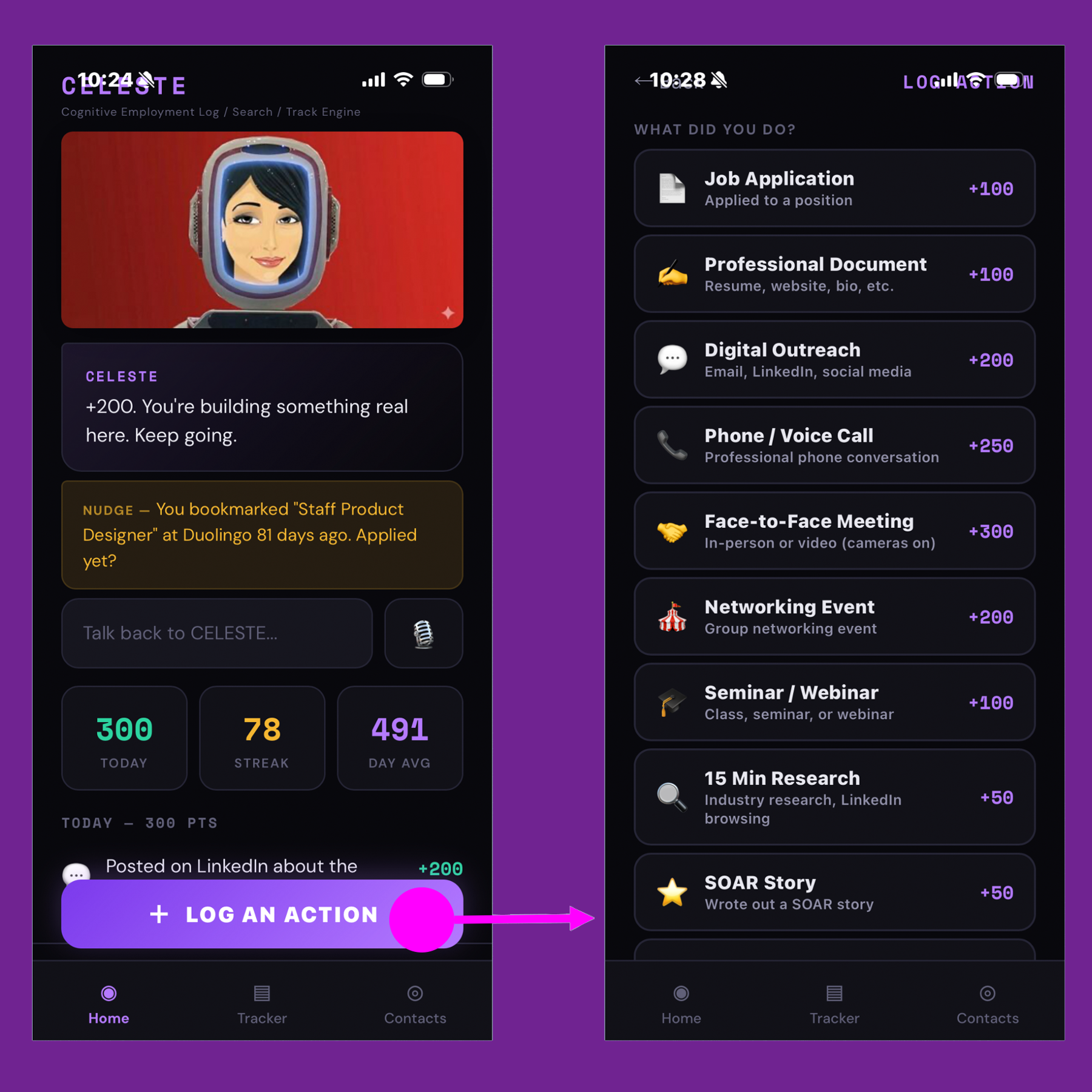
Celeste Homepage and Job Search Action Logging page (portion). February 2026.
The interface
I had designed the basic UX in 2018 as a course project, so I had a visual system to build from. The home screen prominently features a cartoony face that can perform emotional expression, and this turned out to be a powerful behavior influencer. It also shows today's points, your current streak, and your daily average for the month — three numbers that tell you everything about where you stand (and why CELESTE is looking at you that way). The log screen lets you record any action in seconds. The tracker tab lets you look over what you’ve been doing and the contacts tab surfaces who you haven't connected with recently.
I worked with Claude to translate my wireframes into a working app, then conducted ongoing conversational QA as I went — squashing bugs, generating user feedback, and discovering new features to add.
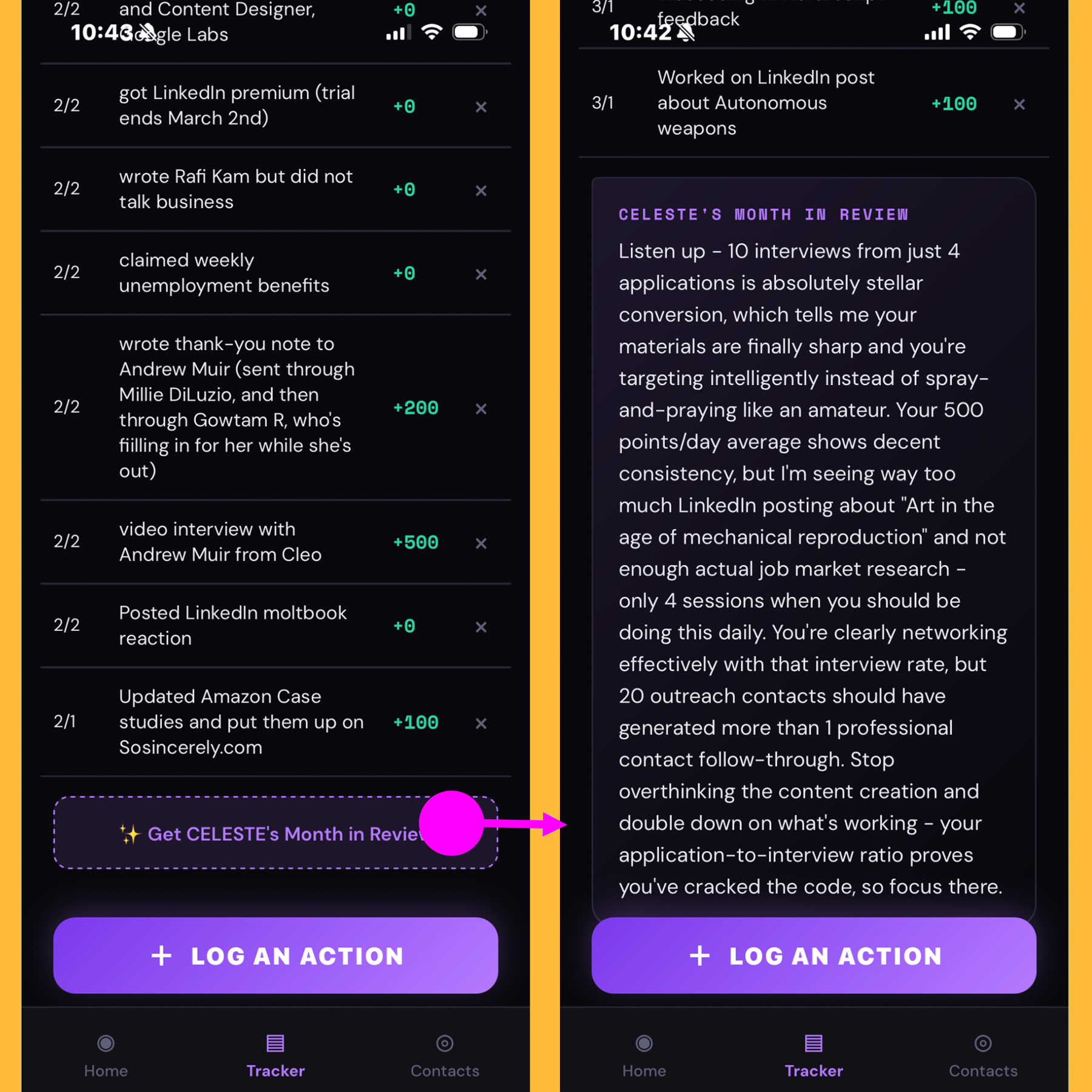
CELESTE's Month in Review feature: AI-generated monthly job search analysis with performance feedback and candid coaching. April 2026.
The Month in Review
One feature that emerged recently: CELESTE now does a 'Spotify Wrapped'-esque analysis of my job search month—here's what I did well, here's what I’m underinvesting in, getting in a few funny digs at me (backed up by research, so it’s pretty on the nose) in a supportive way. It's data-driven, a little funny, and on the nose in ways that generic encouragement never is. That came from actually using the system and noticing gaps.
The beauty of owning the whole experience is that I can push new features the moment I notice a gap in real usage. The Month in Review didn't come from a product brief — it came from realizing I wanted to know more about my own patterns.
THE RESULTS
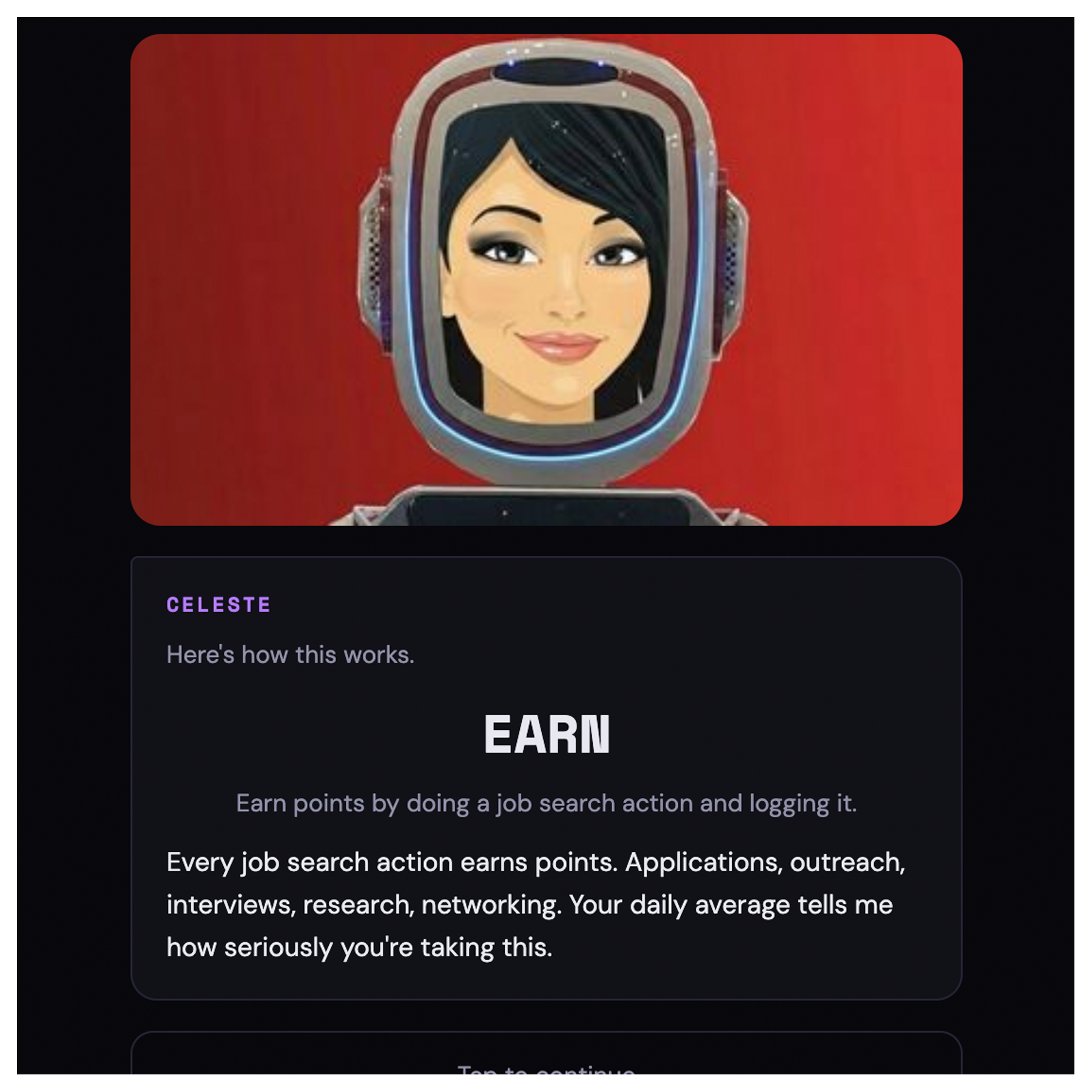
Celeste introduces herself to a first time user. Onboarding screen (WIP). May 2026.
CELESTE is deployed, live, and running my actual job search — and starting to grow beyond it.
At a glance I can see: who haven't I connected with in a while? How many applications this week, and which ones need follow-up? Am I doing enough networking, or am I hiding behind resume work? Having a system that knows what I'm doing, analyzes it, and responds to it keeps me in motion. It prevents the loneliness of job searching from becoming paralysis.
The product has continued to evolve through real use. I recently completed an onboarding sequence for first-time users — introducing CELESTE's personality, explaining the point system, and setting expectations for how she communicates — because I realized that landing in an app with an opinionated AI character requires some runway. You have to earn the roast.
The next phase is getting other job seekers to try it. I'm currently working out how to recruit beta users for unmoderated testing — people going through real job searches who can give me a wider perspective on which features are genuinely useful, which need refinement, and what I'm not seeing because I designed it for myself. Designing for one user (yourself) is a powerful way to start, but it's a limiting way to finish.

What building CELESTE taught me about voice, utility, and trust
Being the designer, developer, and daily user forced me to live every trade-off in real time in a way that designing for other people never quite does.
Should CELESTE be encouraging or hard on me? Does she build dependence or independence? How much roasting is too much? These aren't abstract questions when you're the one opening the app at 11pm after a rough day.
What I learned is that personality and utility are inseparable. The voice of a system is not a layer on top of what it does. It is what it does. CELESTE's tone (the Tiger Mom push, the genuine celebration when you hit 600 points, the flat anger when you've gone silent for two days) is more than simple flavoring. It's the mechanism of behavior change.
Working on CELESTE has also expanded my view on AI sycophancy. We’re so accustomed to virtual agents being overwhelmingly positive that when CELESTE is pointed and angry, it hits very hard and cuts through in a way that gets your attention. I don’t know if it’s for everyone (yet) but I hypothesize there are some people who need a system like this.
That's what I was reaching for with the Jeffrey Ross app in 2012. That's what CELESTE is now. And that's the design problem I want to keep solving.